- Mailing Lists
- Contributors
- Bug Report
Archives
- By thread 1419
-
By date
- August 2019 59
- September 2019 118
- October 2019 165
- November 2019 97
- December 2019 35
- January 2020 58
- February 2020 204
- March 2020 121
- April 2020 172
- May 2020 50
- June 2020 158
- July 2020 85
- August 2020 94
- September 2020 193
- October 2020 277
- November 2020 100
- December 2020 159
- January 2021 38
- February 2021 87
- March 2021 146
- April 2021 73
- May 2021 90
- June 2021 86
- July 2021 123
- August 2021 50
- September 2021 68
- October 2021 66
- November 2021 74
- December 2021 75
- January 2022 98
- February 2022 77
- March 2022 68
- April 2022 31
- May 2022 59
- June 2022 87
- July 2022 141
- August 2022 38
- September 2022 73
- October 2022 152
- November 2022 39
- December 2022 50
- January 2023 93
- February 2023 49
- March 2023 106
- April 2023 47
- May 2023 69
- June 2023 92
- July 2023 64
- August 2023 103
- September 2023 91
- October 2023 101
- November 2023 94
- December 2023 46
- January 2024 75
- February 2024 79
- March 2024 104
- April 2024 63
- May 2024 40
- June 2024 160
- July 2024 80
- August 2024 70
- September 2024 62
- October 2024 121
- November 2024 117
- December 2024 89
- January 2025 59
- February 2025 104
- March 2025 96
- April 2025 107
- May 2025 52
- June 2025 72
- July 2025 60
- August 2025 81
- September 2025 124
- October 2025 63
- November 2025 22
Contributors
🎫 Jueves Adhoc Live: Quickstart: el Sistema de Gestión para escalar tu Pyme sin gastar fortuna
migration from 16.0 to 17.0
Bug Report
Hi Team,
I hope you are well.
I would like to share another vulnerability of your website
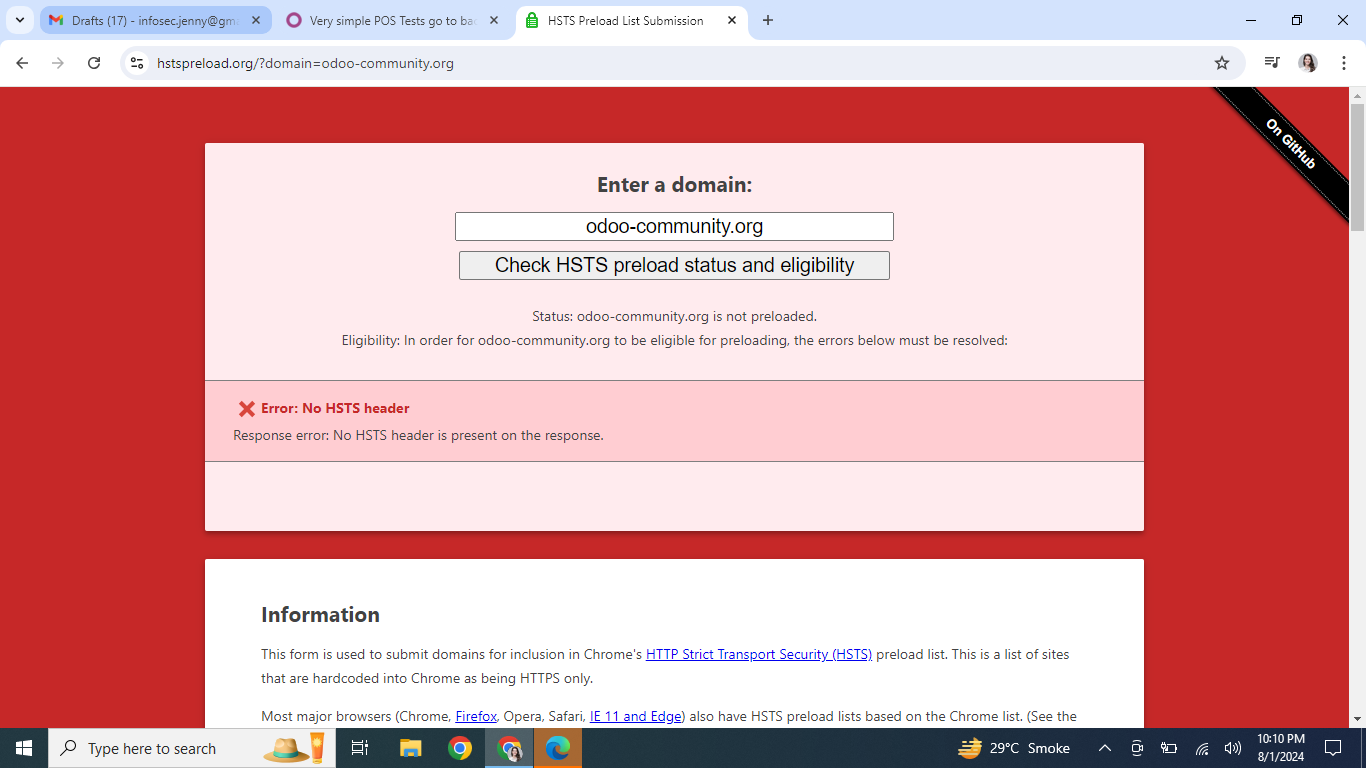
Vulnerability 1: Non - secure requests are not automatically upgraded to HTTPS | HSTS missing
Description
The application fails to prevent users from connecting to it over unencrypted connections. An attacker able to modify a legitimate user's network traffic could bypass the application's use of SSL/TLS encryption, and use the application as a platform for attacks against its users. This attack is performed by rewriting HTTPS links as HTTP so that if a targeted user follows a link to the site from an HTTP page, their browser never attempts to use an encrypted connection. The sslstrip tool automates this process.
To exploit this vulnerability, an attacker must be suitably positioned to intercept and modify the victim's network traffic. This scenario typically occurs when a client communicates with the server over an insecure connection such as public Wi-Fi, or a corporate or home network that is shared with a compromised computer. Common defenses such as switched networks are not sufficient to prevent this. An attacker situated in the user's ISP or the application's hosting infrastructure could also perform this attack. Note that an advanced adversary could potentially target any connection made over the Internet's core infrastructure.
Steps to Reproduce:
1) Go to https://hstspreload.org/ or https://securityheaders.com/
2) enter your domain
References
HTTP Strict Transport Security
sslstrip
HSTS Preload Form
Impact:
The application should instruct web browsers to only access the application using HTTPS. To do this, enable HTTP Strict Transport Security (HSTS) by adding a response header with the name 'Strict-Transport-Security' and the value 'max-age=expireTime', where expireTime is the time in seconds that browsers should remember that the site should only be accessed using HTTPS. Consider adding the 'includeSubDomains' flag if appropriate.
Note that because HSTS is a "trust on first use" (TOFU) protocol, a user who has never accessed the application will never have seen the HSTS header, and will therefore still be vulnerable to SSL stripping attacks. To mitigate this risk, you can optionally add the 'preload' flag to the HSTS header, and submit the domain for review by browser vendors.
Vulnerability 2 : Strict transport security not enforced
Path: odoo-community.org
Issue Description:
The application fails to prevent users from connecting to it over unencrypted connections. An attacker able to modify a legitimate user's network traffic could bypass the application's use of SSL/TLS encryption, and use the application as a platform for attacks against its users. This attack is performed by rewriting HTTPS links as HTTP, so that if a targeted user follows a link to the site from an HTTP page, their browser never attempts to use an encrypted connection. The sslstrip tool automates this process.
To exploit this vulnerability, an attacker must be suitably positioned to intercept and modify the victim's network traffic.This scenario typically occurs when a client communicates with the server over an insecure connection such as public Wi-Fi, or a corporate or home network that is shared with a compromised computer. Common defenses such as switched networks are not sufficient to prevent this. An attacker situated in the user's ISP or the application's hosting infrastructure could also perform this attack. Note that an advanced adversary could potentially target any connection made over the Internet's core infrastructure.
Issue remediation:
The application should instruct web browsers to only access the application using HTTPS. To do this, enable HTTP Strict Transport Security (HSTS) by adding a response header with the name 'Strict-Transport-Security' and the value 'max-age=expireTime', where expireTime is the time in seconds that browsers should remember that the site should only be accessed using HTTPS. Consider adding the 'includeSubDomains' flag if appropriate.
Note that because HSTS is a "trust on first use" (TOFU) protocol, a user who has never accessed the application will never have seen the HSTS header, and will therefore still be vulnerable to SSL stripping attacks. To mitigate this risk, you can optionally add the 'preload' flag to the HSTS header, and submit the domain for review by browser vendors.
Looking forward to hearing from you soon.
Kind Regards.
by "Jenny Rose" <infosec.jenny@gmail.com> - 07:11 - 1 Aug 2024